IUI Cost: Complete 2026 Pricing Guide for Artificial Insemination

Looking into intrauterine insemination (IUI) costs? Here’s what you need to know upfront: you’re looking at $500 to $4,000 per cycle. With insurance, that drops to $300-$1,000 out of pocket.

Why such a big range? It depends on whether you need medications, how much monitoring your doctor orders, if you’re using a sperm donor, and what your insurance actually covers.

Here’s the reality: most people need 3-4 tries before it works. So you’re not budgeting for one cycle: you’re actually planning for several.

In this guide, you’ll find:

  • What you’ll actually pay based on your treatment type.
  • Every line item on your IUI bill, explained.
  • How to work with your insurance
  • Real ways to cut costs without cutting corners.

Let’s break down the numbers so you can plan accordingly.

IUI Cost at a Glance: What You’ll Actually Pay

Here’s the bottom line on what artificial insemination costs, broken down by protocol:

Treatment TypeTotal Cost Per Cycle
Natural Cycle IUI$500 - $1,500
IUI with Clomid/Letrozole$1,000 - $2,000
IUI with Injectable Meds$2,500 - $4,000+
Sperm Donor+$1,000 - $2,500

Natural Cycle IUI: $500-$1,500

This is the most affordable option, because you’re not taking fertility medications: your doctor just tracks your natural ovulation.

  • What’s included: Monitoring visits, the insemination procedure, sperm processing.
  • Who this works for: People with regular cycles who ovulate on their own, or those wanting to start with the most conservative (and affordable) approach.

IUI with Oral Medications (Clomid/Letrozole): $1,000-$2,000

Adding Clomid or Letrozole helps induce ovulation and can increase your chances of releasing multiple eggs (superovulation).

  • What’s included: Everything in natural cycle, plus oral medication ($50-$150).
  • IUI success rates: Slightly better than natural cycle, especially if you have irregular ovulation.
  • Who this works for: People with ovulation issues, PCOS, or unexplained infertility.

IUI with Injectable Medications: $2,500-$4,000+

Injectable gonadotropins are the heavy hitters: they stimulate your ovaries more aggressively than pills.

  • What’s included: Everything above, plus injectable medications ($1,500-$2,500) and more frequent monitoring.
  • The trade-off: Higher IUI success rates, but also higher cost and increased risk of multiples (twins or triplets).
  • Who this works for: People who didn’t respond to oral meds, those with low ovarian reserve, or when doctors want a more aggressive approach.

IUI with Donor Sperm: Add $1,000-$2,500

Using a sperm donor adds significant costs on top of your base IUI price.

What you’re paying for:

  • Sperm vials: $800-$2,200 per vial
  • Shipping: $150-$400
  • Long-term storage (if needed):  $750 – $1200/year
  • Sometimes: genetic counseling or legal fees

Who needs this: Same-sex female couples, single parents by choice, couples with severe male factor infertility

These totals include consultation, testing, monitoring, medications, and the procedure itself. The exact amount depends on which protocol your doctor recommends based on your diagnosis.

Inside Your Artificial Insemination Cost: Component-by-Component Breakdown

Want to know where your intrauterine insemination money actually goes? Here’s every expense you’ll encounter.

Cost ComponentPrice Range
Consultation & Testing$225 - $800
Medications$50 - $2,500
Monitoring & Ultrasounds$300 - $1,000
Sperm Processing$150 - $400
IUI Procedure$150 - $400
Sperm Donor (if needed)$1,000 - $2,500
Hidden/Extra Costs$200 - $1,000

Pre-Treatment Costs: Consultation & Testing ($225-$800)

Before you start, your doctor needs baseline info:

  • Initial consultation: $225-$500.
  • Bloodwork to check hormone levels.
  • Ultrasounds of your uterus and ovaries.
  • Semen analysis: $100-$300.

Most insurance covers diagnostic testing even if they won’t cover IUI itself.

Medication Costs ($50-$2,500)

This is where the range gets wild:

  • Natural cycle: $0-$50 (maybe just a trigger shot).
  • Clomid or Letrozole: $50-$150.
  • Injectable gonadotropins: $1,500-$2,500.
  • Trigger shot (hCG): $50-$250.

Your protocol depends on your diagnosis and how your body responds.

Monitoring Costs ($300-$1,000)

Your doctor tracks your cycle with:

  • 2-4 ultrasound visits at $150-$300 each.
  • Blood work to check hormone levels.
  • Follicle tracking and ovulation timing to time insemination perfectly.

Injectable cycles need more monitoring than natural or oral medication cycles.

Lab Processing Costs ($150-$400)

Sperm washing and processing for optimal sperm quality:

  • Removes seminal fluid.
  • Isolates the healthiest sperm.
  • Required for both partner and donor samples (unless donor sperm vial purchased has previously been washed “washed/processed”).
  • Fresh sperm processed same-day; frozen sperm thawed first.

The Procedure Fee ($150-$400)

The actual insemination:

  • Takes 5-10 minutes.
  • Catheter placed through cervix.
  • Washed sperm inserted directly into uterus.
  • Done by your doctor or nurse practitioner.

Donor Sperm Costs (If Applicable) ($1,000-$2,500+)

If you’re using a sperm donor:

  • Sperm vials: $800-$2,200 each.
  • Shipping: $150-$400.
  • Storage: $200-$500/year.
  • Extra counseling/legal: $300-$1,000.

Most people buy multiple vials upfront for consistency across cycles or future siblings.

Other Costs You Should Expect ($200-$1,000)

The stuff no one mentions upfront:

  • Repeat semen analysis if needed.
  • Pregnancy tests post-IUI.
  • Time off work for appointments.
  • Travel, parking, gas.
  • Therapy or support groups.

Factors That Influence Your Total Cost

Not everyone pays the same amount for IUI treatment. Here’s what drives your final bill up or down.

Your Diagnosis and Treatment Plan

  • Unexplained infertility usually starts with natural cycle or oral meds, for lower cost, less aggressive approach.
  • Mild male factor infertility might need sperm processing to improve sperm quality but can often work with simpler protocols.
  • Age matters: If you’re over 35, doctors might push for injectable medications right away to maximize your chances (which means higher upfront costs).
  • Your body’s response: Some people need higher medication doses or more monitoring visits, which adds up fast.

Geographic Location and Clinic Choice

Where you live changes what you pay:

  • Urban areas: Expect to pay 20-30% more than rural clinics.
  • West Coast and Northeast: Highest prices (think $3,500+ for medicated IUI).
  • Midwest and South: More affordable (closer to $1,500-$2,500).

Clinic reputation also plays a role. High-success-rate clinics can charge premium prices, but they might get you pregnant faster, meaning fewer total cycles, and therefore lower overall cost.

Number of IUI Cycles Needed

Here’s the reality: most people need 3-4 cycles before intrauterine insemination works (or before they move to IVF).

The math:

  • 1 cycle at $2,000 = $2,000.
  • 3 cycles at $2,000 = $6,000.
  • 4 cycles at $2,000 = $8,000.

After 3-4 unsuccessful attempts, many doctors recommend switching to IVF. At that point, you need to weigh cumulative costs against one IVF cycle.

Medication Protocol Complexity

  • Natural cycle: Minimal monitoring, no meds except maybe a trigger shot. That’s the cheapest option.
  • Oral medications: More monitoring than natural, but still relatively simple.
  • Injectable medications: Daily injections, frequent monitoring appointments (sometimes every other day), careful tracking to avoid overstimulation. That’s the most expensive option.

Your protocol isn’t always your choice. Your doctor bases it on your diagnosis, age, and how you’ve responded to previous treatments.

Month-by-Month Cost Timeline: What to Expect When

Here’s when you’ll actually need to pay for everything, so you can plan your cash flow.
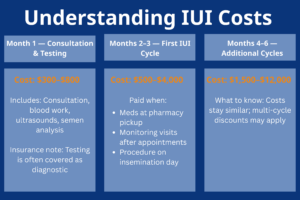
Month 1: Consultation and Testing Phase ($300-$800)

What happens: Initial appointment, fertility testing, treatment planning.

When you pay:

  • Consultation fee: usually due day-of.
  • Blood work and ultrasounds: billed within 1-2 weeks.
  • Semen analysis: paid upfront at most labs.

Insurance note: If you have coverage, fertility testing is often covered as “diagnostic” even if IUI treatment itself isn’t.

Month 2-3: First IUI Cycle Costs ($500-$4,000)

What happens: Your actual first treatment cycle.

Payment timeline:

  • Medications: Paid when you pick them up from pharmacy (beginning of cycle).
  • Monitoring visits: Usually billed after each appointment or at cycle end.
  • Procedure fee: Due on insemination day or billed shortly after.

Pro tip: Some clinics want payment upfront for the full cycle. Others bill as you go. Ask before you start.

Months 4-6: Additional Cycles (If Needed) ($1,500-$12,000)

What changes: Not much! Cycle costs stay pretty consistent.

What to know:

  • Medication doses might adjust based on your response.
  • You might need less baseline testing (one ultrasound instead of full workup).
  • Some clinics offer multi-cycle discounts if you prepay.

Reality check: By cycle 3 or 4, you and your doctor will discuss whether to continue IUI or move to IVF.

Ongoing Costs After Success or Moving On

If you get pregnant:

  • Early monitoring: $200-$500 (ultrasounds and blood work to confirm pregnancy).
  • You’ll transition to regular OB care after 8-10 weeks.

If you don’t:

  • Storage fees if you have frozen sperm: $200-$500/year.
  • Consultation to discuss next steps: sometimes included, sometimes $200-$300.
  • Emotional support: therapy sessions, support groups. Factor this into your budget.

Insurance Coverage for IUI: What’s Covered and What’s Not

Insurance and IUI is a mess, and infertility insurance coverage varies wildly. Some plans cover everything, some cover nothing, most cover something in between. Here’s how to figure out where you stand.

How Insurance Coverage Affects Out-of-Pocket Costs

With good coverage: You might pay $300-$1,000 per cycle (copays, deductibles, coinsurance).

With partial coverage: You might pay $1,500-$2,500 (they cover monitoring and procedure but not meds, or vice versa).

With no coverage: You’re paying the full $500-$4,000.

How it works:

  • Deductible: You pay this amount first before insurance kicks in.
  • Copay: Fixed amount per visit or service.
  • Coinsurance: You pay a percentage (like 20%) after meeting deductible.

What Insurance Typically Covers

Most plans that cover fertility treatment will pay for:

  • Diagnostic testing: Blood work, ultrasounds, semen analysis (often covered even when IUI isn’t).
  • Monitoring visits: The ultrasounds and blood work during your cycle.
  • The IUI procedure itself: The actual insemination.
  • Some medications: Varies wildly. Some cover everything, some cover nothing.

What Insurance Often Doesn’t Cover

Even “good” fertility coverage usually excludes:

  • Donor sperm and related costs: You’re on your own for vials, shipping, storage.
  • Injectable medications: Many plans only cover oral meds like Clomid.
  • Cycles beyond their limit: Common caps are 3-6 IUI cycles.
  • Storage fees: Annual sperm storage rarely covered.

The catch: Some plans cover IUI for “medical infertility” but not for same-sex couples or single parents—even though the treatment is identical.

State Mandates and Fertility Coverage

  • 21 states require some level of fertility coverage. But there are massive loopholes:
    • Self-funded employer plans are exempt (about 60% of employer plans).
    • Mandates vary: Some require full coverage, others just require it be “offered”.
    • Definition of infertility matters: Some states require 12+ months of trying; same-sex couples often can’t meet this requirement.
  • States with strong mandates: Massachusetts, Illinois, New York, Connecticut, California (as of 2024) Check your state: Even if your state has a mandate, your specific plan might not be required to follow it.

Financing Options for IUI Treatment

If you’re paying out of pocket or have high out-of-pocket costs, here are your options for making fertility treatment work financially.

Payment Plans and Medical Financing

Fertility-specific lenders:

  • FutureFamily, Sunbit, CapexMD: Specialize in fertility financing.
  • Loan amounts: $1,000-$50,000+.
  • Terms: 3-60 months.
  • Interest rates: 6-20% depending on credit.

Clinic payment plans:

  • Some clinics offer in-house payment plans (interest-free or low-interest).
  • You pay in installments over 6-12 months.
  • Usually requires credit check and down payment.

The reality: Financing makes treatment accessible now, but you’re paying more overall due to interest.

Health Savings Accounts (HSA) and FSA

If you have an HSA or FSA, use it. IUI expenses are eligible, and you’re paying with pre-tax dollars.

What qualifies:

  • All IUI treatment costs (consultation, monitoring, procedure, meds).
  • Donor sperm.
  • Travel to appointments (mileage, parking).

2026 contribution limits:

  • FSA: $3,200/year.
  • HSA: $4,150 individual / $8,300 family.

Strategy: Max out contributions at the start of the year if you’re planning IUI cycles.

Grants and Financial Assistance Programs

Free money exists, but it’s competitive:

Organizations offering fertility grants:

  • Baby Quest Foundation: Grants up to $15,000.
  • The Tinina Q. Cade Foundation: For women of color.
  • Pay It Forward Fertility Foundation: For LGBTQ+ families.
  • Cade Foundation: Cancer survivors.
  • Gift of Parenthood: Various grant programs.

Reality check:

  • Application deadlines are specific (usually quarterly)
  • Acceptance rates are low (10-20%)
  • You need to share your story and financial info
  • Processing takes 2-6 months

Worth applying? Yes, if you have time before starting treatment. Worst case: you don’t get it. Best case: free IUI cycle.

Employer Benefits and Fertility Coverage

More companies are adding fertility benefits. Even if your insurance doesn’t cover it, check if your employer offers:

  • Third-party fertility benefit programs like Carrot.
  • Reimbursement programs: Some employers reimburse fertility costs up to a certain amount.
  • Supplemental coverage: Additional benefit you can opt into.

If your employer doesn’t offer anything: Consider asking HR about adding fertility benefits. Frame it as a competitive advantage for recruiting and retention.

How to Reduce Your Artificial Insemination Costs Without Compromising Care

You don’t have to pay full price for everything. Here’s how to cut costs strategically.

Ask About Package Pricing and Multi-Cycle Discounts

Multi-cycle bundles:

  • Pay upfront for 3-4 cycles and save 10-20%.
  • Example: Pay $5,000 for 3 cycles instead of $2,000 each ($6,000 total).

Refund programs:

  • Some clinics offer money-back guarantees.
  • If you don’t get pregnant after X cycles, you get a partial refund.
  • Usually costs more upfront but reduces financial risk.

Shared risk programs:

  • Pay one price for multiple attempts.
  • If unsuccessful, get 70-100% refund.
  • Not common for IUI (more typical for IVF), but ask anyway.

Compare Medication Costs and Use Generic Options

Medications are where you can save the most.

Use generic when possible.

  • Generic Clomid (clomiphene): $15-$30 vs. brand name $50-$100.
  • Generic Letrozole: $10-$40 vs. Femara $100+.

Shop around for injectables:

  • Prices vary wildly between pharmacies.
  • Call these specialty pharmacies: Alto, Freedom Fertility, MDR, IVFPrescriptions.
  • Price difference can be $500+ for the same medication.


International pharmacies:

  • Some people order from Canadian or overseas pharmacies.
  • Significantly cheaper BUT there are legal/safety considerations.
  • Discuss with your doctor first.

Consider Natural Cycle or Minimal Stimulation IUI First

Start simple, escalate if needed:

  • Try 1-2 natural cycles before adding medications (if you ovulate regularly).
  • Saves $500-$2,000 per cycle.
  • If natural doesn’t work, then move to oral meds.
  • If oral doesn’t work, then try injectables.

When this makes sense:

  • You’re under 35 with regular cycles.
  • No major fertility issues identified.
  • You’re willing to try a few times.

When to skip it:

  • You’re over 38 (time matters more than money).
  • You have known ovulation issues.
  • Male factor requires more aggressive approach.

Maximize Your Insurance Benefits

Get pre-authorization before starting:

  • Prevents surprise denials.
  • Confirms what’s covered upfront.
  • Get it in writing.

Submit claims properly:

  • Use correct billing codes.
  • Submit itemized receipts.
  • Keep copies of everything.

Appeal denied claims:

  • Insurance companies deny 20% of claims incorrectly.
  • Write an appeal letter with your doctor’s support.
  • Cite your policy language and medical necessity.
  • Second appeals have 50% success rate.

Stay in-network:

  • Out-of-network can cost you 2-3x more.
  • Verify every provider (clinic, lab, pharmacy) is in-network.

Time Your Treatment Strategically

Play the deductible game:

Option 1: Start in January

  • Your deductible resets.
  • If you need multiple cycles, you’ll hit out-of-pocket max faster.
  • Better for people expecting to do 3+ cycles.

Option 2: Start in November/December

  • If you’ve already met your deductible for the current year.
  • Get one cycle covered at 100%, then continue into new year.

Example:

  • Your deductible is $3,000.
  • You’ve already spent $2,500 on healthcare this year.
  • Starting IUI now means your first cycle is only $500 out of pocket.

Get Your Intrauterine Insemination Cost Estimate

You’ve got the numbers. You understand the variables. Now it’s time to get your personalized cost estimate and move forward.

Here’s what you know: intrauterine insemination ranges from $500-$4,000 per cycle depending on your protocol, insurance can cut that significantly, financing options exist, and most people budget for 3-4 cycles.

At California Center for Reproductive Health, we believe in complete transparency. No surprise bills. No hidden fees. Just honest pricing from day one.

Why CCRH:

  • Success rates 2x the national average. And fewer cycles means lower total cost.
  • 20+ years of experience helping thousands of families.
  • Upfront cost breakdowns before you commit to anything.

Your next step: Schedule your first consultation with us. You’ll meet with our team, discuss your specific situation, and receive a detailed cost estimate tailored to your diagnosis and insurance coverage. We’ll help you understand exactly what you’ll pay and when, plus connect you with financing options if needed.

We’re committed to making your family-building journey as affordable and stress-free as possible. No games, no pressure: just real answers about real costs.

What is the Best Fertility Treatment for Endometriosis?

Endometriosis is a disorder that’s often painful in which tissue that usually lines the inside of the uterus grows outside the uterus. This condition can make getting pregnant challenging since fallopian tubes, ovaries, and surrounding areas may be inflamed or scarred. As many as half of the women with this condition struggle with infertility. What is the best fertility treatment for endometriosis?

A variety of forms of assisted reproductive technologies may make it possible for women with endometriosis to attain a successful pregnancy. The experts at the Center for Reproductive Health can determine the best fertility treatment for you based on your unique situation.

Determining the Severity of Endometriosis

To find the best fertility treatment for you if you have endometriosis, your doctor needs to determine the severity of your condition. In the early stages of endometriosis, not many areas have been affected and there’s no scar tissue. In the later stages of endometriosis, tissue may be implanted in extensive areas of the abdomen and there may be scar tissue.

Medicine, surgery, or both may be recommended to treat your endometriosis. If your endometriosis is at an early stage and you’re under the age of 35, surgical removal of the tissue may be all the treatment you need for pregnancy to occur naturally. This type of surgery is usually done laparoscopically. 

In Vitro Fertilization

In some women, even if endometrial tissue is removed, it grows back, which may lead to the need for other types of fertility treatment. In severe endometriosis, there may be damage to the ovaries or eggs, and the fallopian tubes may be blocked or damaged. Medication to stimulate the ovaries may help in some cases, but there’s a good chance that women with infertility related to endometriosis may need to consider in vitro fertilization (IVF) to attain a successful pregnancy.

IVF can bypass some of the fertility problems caused by endometriosis. There are several steps involved in treatment using IVF. Your doctor may give you injections of medication to trigger ovulation and encourage multiple eggs to be produced in the ovaries. Eggs are removed from the ovaries by your fertility doctor during a minor surgical procedure. These eggs are combined with sperm from your partner or from a sperm donor in a lab where fertilized eggs can be monitored to see if fertilization has been successful. 

Fertilizing eggs in a lab setting minimizes the risk of egg or sperm damage from endometriosis. Once fertilized eggs have grown into embryos, one or more embryos are implanted directly into the uterus, which bypasses blocked fallopian tubes. Extra embryos can be frozen for future use or can be donated to another couple. About twelve days after embryos are implanted, a pregnancy test is done. If you haven’t gotten pregnant, you’ll discuss with your fertility doctor whether to try another cycle of IVF.

The fertility specialists at the Center for Reproductive Health consider your endometriosis along with other factors such as your age and overall health when determining the best type of fertility treatment for you. Call today to learn more or to schedule a consultation.

How to Prepare for Fertility Treatment

Many couples experience the disappointment of having month after month pass without being able to get pregnant. Making the decision to find out about fertility treatment takes both courage and commitment. Once you’ve made that decision, the next thing to do is to find out how to prepare for fertility treatment so you can be ready for what’s ahead. 

When you’re ready to go through fertility treatment, it’s important to work with reputable and compassionate experts in the field of assisted reproductive technologies. That’s exactly what you’ll find at the Center for Reproductive Health.

Work on Your Overall Health

Fertility treatment results in a successful pregnancy for many people, but unfortunately, it doesn’t work for everyone. There are some things you can do that may improve your chance of getting pregnant. Work toward attaining a healthy weight, since being either overweight or underweight can affect your hormone levels and may make it more difficult to get pregnant. If you’ve been leading a sedentary lifestyle, make an effort to be more active and to fit exercise into your daily routine. 

Talk to your fertility specialist to find out if you need to take prenatal vitamins or any other supplements. Some supplements such as omega 3s or DHEA are believed to improve sperm count or egg quality.

Break Bad Habits

People often have habits that have consequences on fertility and health. When you’re committed to doing whatever you can to get pregnant, it’s time to break bad habits such as smoking, drinking, or consuming too much caffeine. If you’ve been living on fast food or junk food, work on sticking to healthier food choices. Developing better habits is important for both men and women. Tobacco and caffeine can affect both eggs and sperm.

Another thing to pay attention to is your sleeping habits. Sleep is important for the regeneration of cells, and staying up late night after night can impact your fertility and your overall health.

Stress Management

To a point, stress is part of life and it’s impossible to control or prevent all forms of stress. Uncontrolled stress can take a toll on your overall health and it can interfere with the ability to conceive. There are many things you can do to help manage your stress level. What works for someone else may not work for you, but some things to try include:

  • Meditation
  • Journaling
  • Acupuncture
  • Listening to music
  • Walking
  • Aromatherapy

Talk therapy may be beneficial for reducing stress and for working through feelings of sadness and disappointment that often surround infertility. Practicing yoga can help to tone and strengthen your muscles and can also help to increase blood flow to your reproductive organs and improve your ability to relax.

Working With Your Fertility Team

There are some factors that you can’t control even with good lifestyle choices, such as your age. The chance of attaining success from fertility treatment may get lower for women over 35 or 40. If you’re younger than 35, don’t put off scheduling a consultation for fertility treatment. 

When you’re ready to consider fertility treatment, reach out to the experts at the Center for Reproductive Health. They have the knowledge and experience needed to create a treatment plan that gives you the best chance of attaining a successful pregnancy. Schedule a consultation today.


How to Increase Fertility

There are many factors that can affect fertility. While some things are out of your control, there are some lifestyle changes you might make that could make a difference. While there’s no guarantee that making different lifestyle choices will result in pregnancy, it’s a good idea to give yourself the best possible chance of getting a good result from fertility treatment.

If you’re looking for information on how to increase fertility, your best option is to work closely with the experts at the Center for Reproductive Health. Their knowledgeable staff understands how important it is to have a successful pregnancy and they can help you understand what to focus on if you’re hoping to increase fertility.

Attaining or Maintaining a Healthy Weight

Being overweight or underweight can have an impact on your hormones and on your overall health. In women, any extremes in body weight can affect your menstrual cycle and interfere with ovulation. If you’re underweight, you may have irregular periods and if you do get pregnant, you’re at a higher risk of having a premature baby that has a low birth weight.

Be sure your diet includes foods that are rich in nutrients as well as foods that contain fiber and antioxidants. Avoid eating a lot of fast food or refined carbohydrates such as white sugar and white bread. Work with your healthcare provider if you need help gaining weight or losing weight.

Get Active

A sedentary lifestyle can affect your overall health and can also impact your fertility. Being proactive about including exercise in your daily routine can have a positive effect on fertility in both men and women. If you haven’t been exercising regularly, start slowly and consider activities that might be fun such as dancing or swimming. Work with your doctor to find out what type of exercise would be most beneficial for you and talk about how much exercise would be too much.

Break Bad Habits

When you weren’t thinking about trying to have a baby, you may have acquired some habits that could be harming your health. If you’re a smoker, it’s important to quit. Anything that’s consumed to excess may have a detrimental effect on fertility, so work on limiting the amount of alcohol or caffeine you consume. While it hasn’t been proven that caffeine has an impact on fertility, it makes sense to limit caffeine consumption to one or two cups of coffee or other beverages that contain caffeine each day. Alcohol may have an impact on fertility and may also be harmful to an unborn child if you do get pregnant.

Control Stress

If you’re feeling stressed or overwhelmed, it may hurt your fertility, while managing stress well may improve your chances of getting pregnant.  Make controlling stress a priority. Learn what habits make you feel relaxed such as listening to music, going for a walk or meditating. Some people find that burning candles or journaling has a soothing effect on their mood. 

Make an appointment to talk to the experts at the Center for Reproductive Health for help identifying what changes you can make that may have a beneficial effect on your fertility. 

How to Stay Positive During Fertility Treatment

When you want a child more than anything else but haven’t been able to conceive, you may feel extremely disappointed and sad. You may have a hard time staying positive but you need to work on not allowing negativity to overtake you. Remember that it takes a lot of courage to pursue fertility treatment, and getting the results you want may be a long process. It’s important to know how to stay positive during fertility treatment.

Having a supportive and compassionate team on your side can make a big difference. You can count on the staff at the Center for Reproductive Health to help you navigate the ups and downs of the fertility treatment process.

Coping With Overwhelming Emotions

Fertility treatment can make you feel emotional and out of control. It’s important to avoid allowing overwhelming emotions such as sadness, anxiousness, or discouragement to consume you. Some ways to cope with overwhelming emotions include:

  • Physical activity. Physical activity is a great way to release stormy emotions. Try to fit some form of physical activity such as walking, swimming, or dancing into your daily routine. Quiet forms of physical activity such as yoga, tai chi, or qigong are great ways to focus on the moment and not on emotional turbulence.
  • Journaling.  Writing down your feelings gets them out of your head and helps you sort through what’s really bothering you. Another approach is to make a habit of expressing gratitude on paper or writing about good things that happen to you each day, which keeps your focus off feelings of negativity.
  • Meditation. Meditation refers to several different ways to achieve a state of relaxation. Practice quieting your mind using deep breathing, mantras, or guided meditations.
  • Therapy. A trained psychotherapist can help you sort through feelings of negativity and emotional distress and can recommend tools and practices to help you cope with the way you’re feeling.
  • Ask for help. It’s important to surround yourself with supportive people. Friends and family members may unintentionally say things that make you feel worse. Know where to go to get the emotional support you need, whether it’s your closest friend, an in-person support group, or an online discussion group.

Negative thoughts can creep in and bring you down. Work on being kind to yourself and interrupting any negative thoughts that you might have. Fertility challenges aren’t your fault. Visualize a peaceful place or a positive outcome and think about things in your own life that lift you up. Instead of dwelling on what may or may not happen, take the time for listening to music, playing with a pet, reading a book, watching funny cat videos, or just relaxing.

Keep Learning About Fertility Treatment

Feeling emotional is sometimes triggered by feeling confused or uncertain, so it’s a good idea to get as much information as you can about what to expect during fertility treatment. Don’t hesitate to reach out to the experts at the Center for Reproductive Health with any questions or concerns you may have. 


How to Take Care of Yourself During Fertility Treatment

The wide range of emotions you experience during fertility treatment may feel like you’re on an emotional rollercoaster. The more you dwell on whether or not fertility treatment is going to be successful, the more you may feel overwhelmed or stressed. 

The caring staff members at the Center for Reproductive Health understand what a stressful experience this can be, especially if fertility treatment isn’t successful right away. They’re prepared to help you learn how to take care of yourself during fertility treatment, including both your physical and emotional health.

Take Care of Your Physical Health

Making good lifestyle choices can benefit your overall health, including your reproductive health. Taking care of your physical health may help to improve your chance of a successful pregnancy. Make healthy food choices to make sure you’re getting the nutrients you need. Avoid eating a lot of processed foods and make sure you’re getting enough sleep. 

Exercise can be beneficial both physically and mentally. Some good choices include yoga, walking and riding a bike. Talk to your doctor about the best exercise options for you and about how much exercise to do to prevent injury or over exercising.

Make Self-Care a Priority

Each day, remind yourself to do something you consider fun as part of your daily routine. Work on being in tune with how you’re feeling and think about what you need to do to take care of yourself.  What makes you feel relaxed or calm? 

Give yourself some time to do the things that are soothing to you such as meditation, a bubble bath, reading a good book, listening to music or having a massage.  Practice deep breathing as a way to help yourself to feel calm. Be kind to yourself.

Have a Support System

Feelings of sadness or frustration are natural when you’re having difficulty having a baby, and you’ll need a support system of people you can turn to if you need someone to lean on. This may be your partner, a relative or a close friend.  You may find that those you have turned to in the past don’t know how to provide the support you need, and you may want to consider participating in a support group with others who are also going through fertility treatment. 

Negative emotions shouldn’t be stuffed or ignored. Many people find journaling about overwhelming feelings is a good way to process them. If you find you’re feeling depressed and you have lost interest in being around others or doing things you usually enjoy, it may be time to prioritize getting help from a mental health professional. 

Learning About Fertility Treatment

When you’re going through fertility treatment, learn as much as you can about what to expect. You may experience a lot of highs and lows during this time and the better you understand what’s happening and what’s likely to happen next, the better you’ll be at coping with whatever happens. 

Reach out to the experts at the Center for Reproductive Health for more tips on taking care of yourself during fertility treatment.

When to Seek Fertility Treatment

Many couples experience disappointment and frustration when they decide they’re ready to have a baby but month after month passes without getting pregnant. It may seem like pregnancy should automatically happen without help, but there are many possible causes for having difficulty conceiving that can be corrected. So, how do you know when to seek fertility treatment?

The decision on when or if to seek fertility treatment is a personal one and when you are ready, The Center for Reproductive Health provides compassionate support for couples who are struggling to get pregnant. 

Deciding to Seek Help

Couples under the age of 35 that have spent a year having unprotected intercourse without getting pregnant may need to consider the possibility that pregnancy may not happen without guidance from experts. After the age of 35, your biological clock is ticking and you may not want to postpone seeking guidance longer than six months. The older you get, the more likely you may struggle with infertility and if you’re over the age of 40, you may want to seek help after three months of trying to get pregnant. 

Problems with your reproductive system may need to be addressed even if it’s been less than a year since you’ve been trying to get pregnant. If you’ve had more than one miscarriage, or if you have irregular periods, painful periods, or no periods at all, don’t postpone getting professional guidance. If you have chronic medical conditions such as hypertension, thyroid disease, or diabetes, you may want to work with a fertility specialist.

What Causes Infertility?

Infertility has many possible causes, and consulting experts in the field of assisted reproductive technology can help you uncover what’s at the root of your struggles and then can help you determine the best form of treatment. Some of the possible causes of infertility include:

  • Problems with ovulation
  • Pelvic inflammatory disease
  • Endometriosis
  • Poor egg quality
  • Blocked fallopian tubes
  • Low testosterone
  • Sexual dysfunction
  • Sexually transmitted infections
  • Genetic disorders
  • Exposure to environmental toxins

Lifestyle factors such as obesity, smoking, and substance abuse can also affect your reproductive health. Many of these causes can be corrected, which can improve the chance of getting pregnant. 

Fertility Treatment Options

The best treatment options for you and your partner depend on the cause of infertility. Some reproductive problems can be surgically corrected if necessary and medications are available that can treat hormone imbalances. Some people benefit from changes such as attaining a healthy weight or discontinuing certain medications.

Advances in assisted reproductive technologies have made successful pregnancies possible for many couples. Determining the best form of treatment for you starts with a complete medical exam for both you and your partner which usually includes diagnostic testing. Your doctor also evaluates your family health history and prior pregnancies that you’ve had. 

At the Center for Reproductive Health, you’ll find highly trained and experienced specialists who want to help you reach your goal of a healthy pregnancy. We understand how emotionally draining it can be to have difficulty conceiving, and we treat patients with respect and compassion every step of the way. Schedule a consultation today.


When to Start Fertility Treatment

It’s not uncommon for couples to decide they’re ready to have a baby only to find that pregnancy doesn’t always automatically happen. If you’re among the many people who are struggling, you may feel alone with this problem, but you’re not. Difficulty conceiving affects as many as 10 to 15 percent of couples who want to have a baby. So, how do you know when to start fertility treatment?

Couples who are concerned about their ability to conceive don’t have to struggle alone. The team at the Center for Reproductive Health is available to answer questions and guide couples to find their best options for attaining a successful pregnancy.

How Long Should It Take to Get Pregnant?

While every couple is different, many couples are able to conceive within five to six months of having unprotected sex. Couples that have been trying for a year or more without success may have a problem with infertility. The older you are, the more likely you may struggle with getting pregnant. If you’re older than 35 years of age, it’s a good idea to consult fertility experts if your efforts to conceive aren’t successful within six months. If you’re older than 40 years of age, you may want to talk to a fertility specialist within three months.

Age isn’t the only factor that may affect your ability to conceive. People that have had two or more miscarriages should consider working with fertility experts. If you have conditions such as polycystic ovary syndrome, endometriosis, pelvic inflammatory disease, or irregular periods, they may affect your ability to get pregnant. It’s a good idea to talk to a fertility expert to find out how any of these or other health conditions could be affecting you.

What to Expect During a Fertility Consultation

Infertility has many possible causes. There could be problems with the man, the woman, or both, and many infertile couples have more than one factor affecting their ability to conceive. At a fertility consultation, you discuss both partners’ medical histories with a specialist. You may be asked questions about how long you’ve been trying, whether you’ve been tracking ovulation and whether you have unhealthy habits that could affect your ability to have a healthy pregnancy such as smoking or substance use.

Diagnostic testing and a complete physical exam are usually recommended to try to pinpoint factors affecting your ability to get pregnant. Once these factors are known, a customized treatment plan can be created. You’ll then have the opportunity to discuss all the available options and ask questions about what to expect.

There are more options for treating infertility than ever before and if you’ve been frustrated at your inability to get pregnant for quite a while, it may be time to consider starting fertility treatments. When you work with the experts at the Center for Reproductive Health, you’ll find a team dedicated to providing compassionate and effective care. If you’re ready to find out more about fertility treatments, schedule a consultation today.

How to Finance Fertility Treatment

Many couples have concerns about how to finance fertility treatment. When you’ve been having difficulty conceiving, before making a decision about whether to go forward with fertility treatment, it’s important to understand what services you need so that you can make a decision about what you’re willing to commit to financially. 

Getting fertility treatment can be expensive and understanding all your options can help take away some of the stress related to financing fertility treatment. The team at the Center for Reproductive Health is available to answer any questions you may have about fertility treatment options, including possible ways to finance fertility treatment. 

Check With Your Health Insurance Provider

In many cases, health insurance doesn’t cover the full price of fertility treatment, but it’s a good idea to find out for sure if you have any coverage that may help reduce your overall cost. Contact your health insurance provider and ask if you have any coverage related to infertility. Some parts of the diagnostic testing done as part of your workup may be covered, such as bloodwork or an ultrasound.

Explore Financing Options

Some patients are fortunate enough to have money already saved or available to borrow from family members that can be used to pay for fertility treatment. Other patients are quick to use credit cards, but before immediately putting fertility treatment costs on a credit card, be sure to explore other possible funding options. The interest rates on credit cards can be very high and can lead to financial stress. 

There are a variety of lenders that finance fertility treatment. Some lenders such as CapexMD and New Life Fertility Finance specialize in fertility financing, and they’re familiar with the costs and fees that may be related to fertility treatments. Personal loans through other lending companies may also be an option. Look for flexible financing options and consider loan terms and rates as well as how a loan may affect your overall finances before committing to borrowing money to finance fertility treatment. Crowdsourced funding may be an option for some patients.

Understanding the Total Cost

The overall cost of fertility treatment can vary greatly. Fertility treatment plans may have a wide variety of options such as IVF, surrogates, third-party egg donors, etc. When choosing the best fertility treatment option for you, make sure you understand the total amount you’ll be expected to pay. 

Ask what’s included and not included in the quoted price. Find out whether medications are included in the price quote and whether there are any other costs that may be billed separately. Some questions you may want to ask include:

  • How many rounds of IVF are included in the cost?
  • Are there separate fees for storing eggs and embryos?
  • Are preliminary consultations included in the cost?
  • Are there any assisted reproductive technologies that aren’t included in the price quote?

If you need help understanding your insurance coverage or financing options, the staff at the Center for Reproductive Health wants to help. Reach out today for an appointment or with any questions you may have.