

Looking into intrauterine insemination (IUI) costs? Here’s what you need to know upfront: you’re looking at $500 to $4,000 per cycle. With insurance, that drops to $300-$1,000 out of pocket.
Why such a big range? It depends on whether you need medications, how much monitoring your doctor orders, if you’re using a sperm donor, and what your insurance actually covers.
Here’s the reality: most people need 3-4 tries before it works. So you’re not budgeting for one cycle: you’re actually planning for several.
In this guide, you’ll find:
- What you’ll actually pay based on your treatment type.
- Every line item on your IUI bill, explained.
- How to work with your insurance
- Real ways to cut costs without cutting corners.
Let’s break down the numbers so you can plan accordingly.
IUI Cost at a Glance: What You’ll Actually Pay
Here’s the bottom line on what artificial insemination costs, broken down by protocol:
| Treatment Type | Total Cost Per Cycle |
|---|---|
| Natural Cycle IUI | $500 - $1,500 |
| IUI with Clomid/Letrozole | $1,000 - $2,000 |
| IUI with Injectable Meds | $2,500 - $4,000+ |
| Sperm Donor | +$1,000 - $2,500 |
Natural Cycle IUI: $500-$1,500
This is the most affordable option, because you’re not taking fertility medications: your doctor just tracks your natural ovulation.
- What’s included: Monitoring visits, the insemination procedure, sperm processing.
- Who this works for: People with regular cycles who ovulate on their own, or those wanting to start with the most conservative (and affordable) approach.
IUI with Oral Medications (Clomid/Letrozole): $1,000-$2,000
Adding Clomid or Letrozole helps induce ovulation and can increase your chances of releasing multiple eggs (superovulation).
- What’s included: Everything in natural cycle, plus oral medication ($50-$150).
- IUI success rates: Slightly better than natural cycle, especially if you have irregular ovulation.
- Who this works for: People with ovulation issues, PCOS, or unexplained infertility.

IUI with Injectable Medications: $2,500-$4,000+
Injectable gonadotropins are the heavy hitters: they stimulate your ovaries more aggressively than pills.
- What’s included: Everything above, plus injectable medications ($1,500-$2,500) and more frequent monitoring.
- The trade-off: Higher IUI success rates, but also higher cost and increased risk of multiples (twins or triplets).
- Who this works for: People who didn’t respond to oral meds, those with low ovarian reserve, or when doctors want a more aggressive approach.
IUI with Donor Sperm: Add $1,000-$2,500
Using a sperm donor adds significant costs on top of your base IUI price.
What you’re paying for:
- Sperm vials: $800-$2,200 per vial
- Shipping: $150-$400
- Long-term storage (if needed): $750 – $1200/year
- Sometimes: genetic counseling or legal fees
Who needs this: Same-sex female couples, single parents by choice, couples with severe male factor infertility
These totals include consultation, testing, monitoring, medications, and the procedure itself. The exact amount depends on which protocol your doctor recommends based on your diagnosis.
Inside Your Artificial Insemination Cost: Component-by-Component Breakdown
Want to know where your intrauterine insemination money actually goes? Here’s every expense you’ll encounter.
| Cost Component | Price Range |
|---|---|
| Consultation & Testing | $225 - $800 |
| Medications | $50 - $2,500 |
| Monitoring & Ultrasounds | $300 - $1,000 |
| Sperm Processing | $150 - $400 |
| IUI Procedure | $150 - $400 |
| Sperm Donor (if needed) | $1,000 - $2,500 |
| Hidden/Extra Costs | $200 - $1,000 |
Pre-Treatment Costs: Consultation & Testing ($225-$800)
Before you start, your doctor needs baseline info:
- Initial consultation: $225-$500.
- Bloodwork to check hormone levels.
- Ultrasounds of your uterus and ovaries.
- Semen analysis: $100-$300.
Most insurance covers diagnostic testing even if they won’t cover IUI itself.
Medication Costs ($50-$2,500)
This is where the range gets wild:
- Natural cycle: $0-$50 (maybe just a trigger shot).
- Clomid or Letrozole: $50-$150.
- Injectable gonadotropins: $1,500-$2,500.
- Trigger shot (hCG): $50-$250.
Your protocol depends on your diagnosis and how your body responds.
Monitoring Costs ($300-$1,000)
Your doctor tracks your cycle with:
- 2-4 ultrasound visits at $150-$300 each.
- Blood work to check hormone levels.
- Follicle tracking and ovulation timing to time insemination perfectly.
Injectable cycles need more monitoring than natural or oral medication cycles.
Lab Processing Costs ($150-$400)
Sperm washing and processing for optimal sperm quality:
- Removes seminal fluid.
- Isolates the healthiest sperm.
- Required for both partner and donor samples (unless donor sperm vial purchased has previously been washed “washed/processed”).
- Fresh sperm processed same-day; frozen sperm thawed first.
The Procedure Fee ($150-$400)
The actual insemination:
- Takes 5-10 minutes.
- Catheter placed through cervix.
- Washed sperm inserted directly into uterus.
- Done by your doctor or nurse practitioner.
Donor Sperm Costs (If Applicable) ($1,000-$2,500+)
If you’re using a sperm donor:
- Sperm vials: $800-$2,200 each.
- Shipping: $150-$400.
- Storage: $200-$500/year.
- Extra counseling/legal: $300-$1,000.
Most people buy multiple vials upfront for consistency across cycles or future siblings.
Other Costs You Should Expect ($200-$1,000)
The stuff no one mentions upfront:
- Repeat semen analysis if needed.
- Pregnancy tests post-IUI.
- Time off work for appointments.
- Travel, parking, gas.
- Therapy or support groups.

Factors That Influence Your Total Cost
Not everyone pays the same amount for IUI treatment. Here’s what drives your final bill up or down.
Your Diagnosis and Treatment Plan
- Unexplained infertility usually starts with natural cycle or oral meds, for lower cost, less aggressive approach.
- Mild male factor infertility might need sperm processing to improve sperm quality but can often work with simpler protocols.
- Age matters: If you’re over 35, doctors might push for injectable medications right away to maximize your chances (which means higher upfront costs).
- Your body’s response: Some people need higher medication doses or more monitoring visits, which adds up fast.
Geographic Location and Clinic Choice
Where you live changes what you pay:
- Urban areas: Expect to pay 20-30% more than rural clinics.
- West Coast and Northeast: Highest prices (think $3,500+ for medicated IUI).
- Midwest and South: More affordable (closer to $1,500-$2,500).
Clinic reputation also plays a role. High-success-rate clinics can charge premium prices, but they might get you pregnant faster, meaning fewer total cycles, and therefore lower overall cost.
Number of IUI Cycles Needed
Here’s the reality: most people need 3-4 cycles before intrauterine insemination works (or before they move to IVF).
The math:
- 1 cycle at $2,000 = $2,000.
- 3 cycles at $2,000 = $6,000.
- 4 cycles at $2,000 = $8,000.
After 3-4 unsuccessful attempts, many doctors recommend switching to IVF. At that point, you need to weigh cumulative costs against one IVF cycle.
Medication Protocol Complexity
- Natural cycle: Minimal monitoring, no meds except maybe a trigger shot. That’s the cheapest option.
- Oral medications: More monitoring than natural, but still relatively simple.
- Injectable medications: Daily injections, frequent monitoring appointments (sometimes every other day), careful tracking to avoid overstimulation. That’s the most expensive option.
Your protocol isn’t always your choice. Your doctor bases it on your diagnosis, age, and how you’ve responded to previous treatments.
Month-by-Month Cost Timeline: What to Expect When
Here’s when you’ll actually need to pay for everything, so you can plan your cash flow.
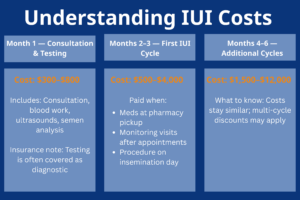
Month 1: Consultation and Testing Phase ($300-$800)
What happens: Initial appointment, fertility testing, treatment planning.
When you pay:
- Consultation fee: usually due day-of.
- Blood work and ultrasounds: billed within 1-2 weeks.
- Semen analysis: paid upfront at most labs.
Insurance note: If you have coverage, fertility testing is often covered as “diagnostic” even if IUI treatment itself isn’t.
Month 2-3: First IUI Cycle Costs ($500-$4,000)
What happens: Your actual first treatment cycle.
Payment timeline:
- Medications: Paid when you pick them up from pharmacy (beginning of cycle).
- Monitoring visits: Usually billed after each appointment or at cycle end.
- Procedure fee: Due on insemination day or billed shortly after.
Pro tip: Some clinics want payment upfront for the full cycle. Others bill as you go. Ask before you start.
Months 4-6: Additional Cycles (If Needed) ($1,500-$12,000)
What changes: Not much! Cycle costs stay pretty consistent.
What to know:
- Medication doses might adjust based on your response.
- You might need less baseline testing (one ultrasound instead of full workup).
- Some clinics offer multi-cycle discounts if you prepay.
Reality check: By cycle 3 or 4, you and your doctor will discuss whether to continue IUI or move to IVF.
Ongoing Costs After Success or Moving On
If you get pregnant:
- Early monitoring: $200-$500 (ultrasounds and blood work to confirm pregnancy).
- You’ll transition to regular OB care after 8-10 weeks.
If you don’t:
- Storage fees if you have frozen sperm: $200-$500/year.
- Consultation to discuss next steps: sometimes included, sometimes $200-$300.
- Emotional support: therapy sessions, support groups. Factor this into your budget.
Insurance Coverage for IUI: What’s Covered and What’s Not
Insurance and IUI is a mess, and infertility insurance coverage varies wildly. Some plans cover everything, some cover nothing, most cover something in between. Here’s how to figure out where you stand.
How Insurance Coverage Affects Out-of-Pocket Costs
With good coverage: You might pay $300-$1,000 per cycle (copays, deductibles, coinsurance).
With partial coverage: You might pay $1,500-$2,500 (they cover monitoring and procedure but not meds, or vice versa).
With no coverage: You’re paying the full $500-$4,000.
How it works:
- Deductible: You pay this amount first before insurance kicks in.
- Copay: Fixed amount per visit or service.
- Coinsurance: You pay a percentage (like 20%) after meeting deductible.
What Insurance Typically Covers
Most plans that cover fertility treatment will pay for:
- Diagnostic testing: Blood work, ultrasounds, semen analysis (often covered even when IUI isn’t).
- Monitoring visits: The ultrasounds and blood work during your cycle.
- The IUI procedure itself: The actual insemination.
- Some medications: Varies wildly. Some cover everything, some cover nothing.
What Insurance Often Doesn’t Cover
Even “good” fertility coverage usually excludes:
- Donor sperm and related costs: You’re on your own for vials, shipping, storage.
- Injectable medications: Many plans only cover oral meds like Clomid.
- Cycles beyond their limit: Common caps are 3-6 IUI cycles.
- Storage fees: Annual sperm storage rarely covered.
The catch: Some plans cover IUI for “medical infertility” but not for same-sex couples or single parents—even though the treatment is identical.
State Mandates and Fertility Coverage
- 21 states require some level of fertility coverage. But there are massive loopholes:
- Self-funded employer plans are exempt (about 60% of employer plans).
- Mandates vary: Some require full coverage, others just require it be “offered”.
- Definition of infertility matters: Some states require 12+ months of trying; same-sex couples often can’t meet this requirement.
- States with strong mandates: Massachusetts, Illinois, New York, Connecticut, California (as of 2024) Check your state: Even if your state has a mandate, your specific plan might not be required to follow it.
Financing Options for IUI Treatment
If you’re paying out of pocket or have high out-of-pocket costs, here are your options for making fertility treatment work financially.
Payment Plans and Medical Financing
Fertility-specific lenders:
- FutureFamily, Sunbit, CapexMD: Specialize in fertility financing.
- Loan amounts: $1,000-$50,000+.
- Terms: 3-60 months.
- Interest rates: 6-20% depending on credit.
Clinic payment plans:
- Some clinics offer in-house payment plans (interest-free or low-interest).
- You pay in installments over 6-12 months.
- Usually requires credit check and down payment.
The reality: Financing makes treatment accessible now, but you’re paying more overall due to interest.
Health Savings Accounts (HSA) and FSA
If you have an HSA or FSA, use it. IUI expenses are eligible, and you’re paying with pre-tax dollars.
What qualifies:
- All IUI treatment costs (consultation, monitoring, procedure, meds).
- Donor sperm.
- Travel to appointments (mileage, parking).
2026 contribution limits:
- FSA: $3,200/year.
- HSA: $4,150 individual / $8,300 family.
Strategy: Max out contributions at the start of the year if you’re planning IUI cycles.
Grants and Financial Assistance Programs
Free money exists, but it’s competitive:
Organizations offering fertility grants:
- Baby Quest Foundation: Grants up to $15,000.
- The Tinina Q. Cade Foundation: For women of color.
- Pay It Forward Fertility Foundation: For LGBTQ+ families.
- Cade Foundation: Cancer survivors.
- Gift of Parenthood: Various grant programs.
Reality check:
- Application deadlines are specific (usually quarterly)
- Acceptance rates are low (10-20%)
- You need to share your story and financial info
- Processing takes 2-6 months
Worth applying? Yes, if you have time before starting treatment. Worst case: you don’t get it. Best case: free IUI cycle.
Employer Benefits and Fertility Coverage
More companies are adding fertility benefits. Even if your insurance doesn’t cover it, check if your employer offers:
- Third-party fertility benefit programs like Carrot.
- Reimbursement programs: Some employers reimburse fertility costs up to a certain amount.
- Supplemental coverage: Additional benefit you can opt into.
If your employer doesn’t offer anything: Consider asking HR about adding fertility benefits. Frame it as a competitive advantage for recruiting and retention.
How to Reduce Your Artificial Insemination Costs Without Compromising Care
You don’t have to pay full price for everything. Here’s how to cut costs strategically.
Ask About Package Pricing and Multi-Cycle Discounts
Multi-cycle bundles:
- Pay upfront for 3-4 cycles and save 10-20%.
- Example: Pay $5,000 for 3 cycles instead of $2,000 each ($6,000 total).
Refund programs:
- Some clinics offer money-back guarantees.
- If you don’t get pregnant after X cycles, you get a partial refund.
- Usually costs more upfront but reduces financial risk.
Shared risk programs:
- Pay one price for multiple attempts.
- If unsuccessful, get 70-100% refund.
- Not common for IUI (more typical for IVF), but ask anyway.
Compare Medication Costs and Use Generic Options
Medications are where you can save the most.
Use generic when possible.
- Generic Clomid (clomiphene): $15-$30 vs. brand name $50-$100.
- Generic Letrozole: $10-$40 vs. Femara $100+.
Shop around for injectables:
- Prices vary wildly between pharmacies.
- Call these specialty pharmacies: Alto, Freedom Fertility, MDR, IVFPrescriptions.
- Price difference can be $500+ for the same medication.
International pharmacies:
- Some people order from Canadian or overseas pharmacies.
- Significantly cheaper BUT there are legal/safety considerations.
- Discuss with your doctor first.
Consider Natural Cycle or Minimal Stimulation IUI First
Start simple, escalate if needed:
- Try 1-2 natural cycles before adding medications (if you ovulate regularly).
- Saves $500-$2,000 per cycle.
- If natural doesn’t work, then move to oral meds.
- If oral doesn’t work, then try injectables.
When this makes sense:
- You’re under 35 with regular cycles.
- No major fertility issues identified.
- You’re willing to try a few times.
When to skip it:
- You’re over 38 (time matters more than money).
- You have known ovulation issues.
- Male factor requires more aggressive approach.
Maximize Your Insurance Benefits
Get pre-authorization before starting:
- Prevents surprise denials.
- Confirms what’s covered upfront.
- Get it in writing.
Submit claims properly:
- Use correct billing codes.
- Submit itemized receipts.
- Keep copies of everything.
Appeal denied claims:
- Insurance companies deny 20% of claims incorrectly.
- Write an appeal letter with your doctor’s support.
- Cite your policy language and medical necessity.
- Second appeals have 50% success rate.
Stay in-network:
- Out-of-network can cost you 2-3x more.
- Verify every provider (clinic, lab, pharmacy) is in-network.
Time Your Treatment Strategically
Play the deductible game:
Option 1: Start in January
- Your deductible resets.
- If you need multiple cycles, you’ll hit out-of-pocket max faster.
- Better for people expecting to do 3+ cycles.
Option 2: Start in November/December
- If you’ve already met your deductible for the current year.
- Get one cycle covered at 100%, then continue into new year.
Example:
- Your deductible is $3,000.
- You’ve already spent $2,500 on healthcare this year.
- Starting IUI now means your first cycle is only $500 out of pocket.
Get Your Intrauterine Insemination Cost Estimate
You’ve got the numbers. You understand the variables. Now it’s time to get your personalized cost estimate and move forward.
Here’s what you know: intrauterine insemination ranges from $500-$4,000 per cycle depending on your protocol, insurance can cut that significantly, financing options exist, and most people budget for 3-4 cycles.
At California Center for Reproductive Health, we believe in complete transparency. No surprise bills. No hidden fees. Just honest pricing from day one.
Why CCRH:
- Success rates 2x the national average. And fewer cycles means lower total cost.
- 20+ years of experience helping thousands of families.
- Upfront cost breakdowns before you commit to anything.
Your next step: Schedule your first consultation with us. You’ll meet with our team, discuss your specific situation, and receive a detailed cost estimate tailored to your diagnosis and insurance coverage. We’ll help you understand exactly what you’ll pay and when, plus connect you with financing options if needed.
We’re committed to making your family-building journey as affordable and stress-free as possible. No games, no pressure: just real answers about real costs.


