

If you and your partner are starting to map out fertility testing costs, a semen analysis is usually the first step, and the first thing most men want to know is what it’ll cost. The honest answer on semen analysis cost: $50 to $300 across most of the country, with $150 to $250 being typical out of pocket. Some cash labs go as low as $30.
The average isn’t really the problem, though. The same basic procedure can run $90 at one center and $400 at another, and whether your insurance helps is a coin toss until you call and ask. So this guide breaks down what you’ll spend by type of test, when insurance actually steps in, and how to keep from overpaying before you book. The price matters, but as you’ll see, what you do with the result matters more.
How Much Does a Semen Analysis Cost?
A standard semen analysis sits in the middle of that range for most people, but the spread is real: as little as $50 at the low end and $300 or more at the high end. The reason is that the term covers everything from a quick sperm count to a multi-part workup. The breakdown below shows where your money actually goes.
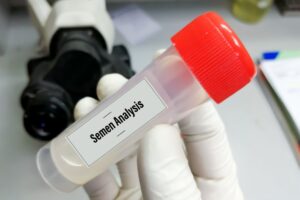
The Standard Price Range
A standard semen analysis looks at three things: sperm concentration (the count), how well the sperm move (motility), and the volume of the sample. That basic version is what most centers quote first, and it usually lands between $50 and $300. You’ll be asked to abstain from ejaculation for a few days first, and to mention any medications, so the sample reflects your real sperm health. The results themselves are a topic of their own, so here’s what you can learn from a semen analysis if you want the full rundown.
Where you fall in the range depends mostly on where you go, which we’ll get to in a minute. For the real-world spread: men on fertility forums report owing as little as $35 when it went toward a deductible, and as much as $400 at a private center for nothing more than the basic exam. Cash marketplaces like MDsave list it for around $30 to $47.
What Each Type of Test Costs
The base figure only covers the basics. Add-on tests each carry their own fee, and they stack fast. Here are the common ones as typical out-of-pocket amounts, though you should confirm locally since labs charge differently:
| Test | Typical self-pay fee |
|---|---|
| Basic semen analysis (count + motility) | $65 to $141 |
| Analysis with morphology | $125 to $268 |
| Antisperm antibody (immunobead) | $150 to $182 |
| Post-ejaculatory urinalysis | $150 to $229 |
| Sperm cryopreservation | $100 to $150 |
| Frozen sperm storage (per year) | $180 to $360 |
| Sperm DNA fragmentation | $300 to $500+ |
Most couples starting out only need the basic analysis, sometimes with morphology added. Advanced testing like sperm DNA fragmentation is ordered separately, usually only when there’s a known problem or a history of miscarriage, and it’s never folded into the base figure.
How Much Prices Vary by Clinic and Location
This is the part that catches people off guard. The same basic procedure, with no extras, can cost four times as much across town. One man in Michigan found an office charging $75 while another nearby wanted $300. In Colorado, labs run $75 to $200, plus a $60 referring physician order fee on top.
A few things drive the gap:
- Type of place. Independent and university labs tend to be cheapest, hospitals sit in the middle, and private fertility centers charge the most.
- Your area. Local cost of living and how many providers compete nearby both move the figure.
- What’s bundled. Whether the doctor’s fee to review your results is included or billed separately.
The takeaway: rates are shoppable. Contact two or three places across your area, find a testing site that quotes clearly, and ask for the all-in cash figure before you commit.

Why Semen Analysis Costs Vary So Much
If a $90 quote and a $400 quote both just say “semen analysis,” what are you actually spending extra on? Four things, mostly.

Facility Type
Where you get tested matters more than almost anything else.
- Independent and university andrology labs are usually cheapest, often $65 to $150. You get a result sheet, but not always someone to explain it.
- Hospital labs sit in the middle and bill through hospital coding, which can complicate what you owe.
- Private fertility centers charge the most, commonly $200 to $500, but the figure usually includes a specialist reading your results and a clear next step if something’s off.
A higher figure isn’t automatically a markup. You’re often spending on the lab’s quality and the specialist’s expertise, which a bare result sheet doesn’t give you.
How Many Parameters Are Tested
Every measurement you add raises the bill. A basic count-and-motility procedure might be $65 to $141. Add morphology, which is the shape of the sperm, and you’re looking at $125 to $268. Antisperm antibody testing is roughly another $150. Sperm DNA fragmentation can add $300 to $500 on its own.
The catch: most first-time testing only needs the basic analysis, maybe with morphology. Focus on that first. Paying for the full panel upfront is the most common way men overspend on a workup they didn’t need yet.
Lab Technology and Accuracy
Some labs analyze your sample by hand under a microscope. Others use computer-assisted semen analysis (CASA), which costs more to run and can nudge the figure up. Neither is automatically more accurate for a basic procedure, but it’s worth knowing what you’re spending on.
The question actually worth asking is whether the lab is CLIA-certified. That tells you it meets federal quality standards, which matters far more than microscope versus machine.
The Hidden Interpretation or Consultation Fee
This is the charge that turns a $150 quote into a $250 bill. Some centers quote you the lab fee but bill separately for a doctor to interpret the results, or for a consultation you’re required to book. Colorado labs, for example, often add a $60 physician order fee.
Before you book, ask one direct question: does this figure include the doctor reviewing my results, or is that billed on top? It’s the easiest way to avoid a surprise at the desk.
Does Insurance Cover a Semen Analysis?
Sometimes. Often not. It depends on your plan and why you’re testing, and plenty of couples cover the cost themselves even with decent insurance. Our full guide to infertility insurance coverage breaks down plan types and mandates, but here’s the short version for a semen analysis specifically.
When It’s Usually Covered
Coverage is most likely when a referring physician orders the test as medically necessary, usually after about 12 months of trying to conceive without success, or for post-vasectomy confirmation. A referral helps, because it gets the procedure coded as diagnostic rather than elective.
State rules matter too, but less than you’d hope. Only about 15 states have infertility mandates, and roughly 7 of those exclude male-factor testing entirely. So even in a mandate state, your semen analysis isn’t guaranteed to be covered. Broader expansions like California’s SB 729 IVF coverage mostly apply to large-group plans starting in 2026, not a diagnostic procedure like this one.
Why Many Couples Still Pay Out of Pocket
Even with coverage on paper, the bill often lands on you. The usual reasons:
- High-deductible plans. The test counts toward your deductible, so you owe the full amount yourself anyway.
- Fertility exclusions. Some plans don’t cover anything fertility-related.
- Testing too early. Before the 12-month mark or a formal diagnosis, insurers may call it elective.
- Out-of-network centers. Many fertility practices don’t contract with insurers at all.
If you’re covering it yourself, $150 to $250 is normal. It doesn’t mean you’re being overcharged. One thing worth checking: if your employer offers a fertility benefit through a platform like Carrot, it may cover testing even when your medical plan won’t.

Self-Pay, Superbills, and Reimbursement
A lot of centers, especially dedicated andrology labs, won’t bill your insurance directly. Instead they hand you an itemized receipt called a superbill, which you submit to your insurer yourself for possible reimbursement.
When you call to book, ask these four things:
- Is the doctor’s interpretation included in the figure?
- Will you bill my insurance, or give me a superbill to submit?
- What’s the cash figure?
- What CPT code will you use? Your insurer can tell you if that code is covered.
How to Pay Less for a Semen Analysis
You have more control over this bill than it looks. A few moves cut what you spend without cutting corners on the result.
Compare Self-Pay Quotes the Right Way
A “$99” quote isn’t cheaper if it leaves out morphology and the doctor’s read, then bills those separately. A “$200” all-in quote can easily come out ahead. So compare like for like.
When you call around, check the same four points each time:
- Which parameters are included: count, motility, morphology?
- Is the physician’s interpretation part of the figure?
- What does a second test cost if you need one?
- Is there a separate order or consultation fee?
Cash-Pay Marketplaces and Diagnostic Labs
The cheapest routes skip the fertility center entirely. Cash marketplaces like MDsave list a semen analysis for around $18 to $47. Independent and university andrology labs run about $65 to $150.
The trade-off: you get a raw result with no one to interpret it, and a sperm count on its own tells you very little about what to do next. That usually means a separate doctor visit later. This works best if you already have a provider lined up to read the numbers. If you don’t, the savings disappear once you add that visit, and you’re back to needing the guidance a fertility center was going to give you anyway.
At-Home Kit Cost vs Clinic Cost
At-home mail-in kits feel cheaper, but the gap is smaller than you’d expect. A kit runs roughly $150 to $225 (Coastal Fertility’s kit is $225 and includes a telehealth consultation), while in-office self-pay sits around $150 to $300. You collect the sample at home, follow the kit instructions, and ship it back to the lab, which delivers your results online. Once you add shipping, a kit often lands right in office territory.
The real risk is a do-over. These kits are built for men unable to collect at a lab, but if an at-home result comes back borderline, you’ll likely need an in-office analysis to confirm it anyway, so the cheapest option upfront can end up costing more.
HSA, FSA, and Financing
A semen analysis is a qualified medical expense, so you can use an HSA or FSA. That’s pre-tax money, which effectively takes 20% to 35% off the figure depending on your tax bracket. Just keep the itemized receipt.
If the procedure is part of a larger fertility workup, some centers offer fertility financing options through services like CareCredit, and fertility-specific lenders like Sunfish can help you spread the cost out. Worth asking about if you’d rather pay over time.

Is a Semen Analysis Worth the Cost?
For a procedure that runs $150 to $250, it’s one of the highest-value things you can do early in a fertility journey. Here’s why.
What That Price Actually Buys You
Male-factor infertility plays a role in about 40% to 50% of couples who struggle to conceive. Skip testing the man and you’re ignoring half the picture, sometimes for months.
For a couple hundred dollars, a semen analysis can save you exactly that: months of guessing, and the far larger cost of treatments like IUI or IVF, where you can pay for a full egg-retrieval cycle chosen before anyone knows what’s going on. A specialist can read the numbers, determine what’s behind a low result, and identify the next step toward conception, whether that’s a lifestyle change, ordinary treatment, or a procedure like sperm extraction when no sperm show up in the sample at all. The reference ranges define what fertile men typically look like, so the result tells you both where your reproductive health stands on the path to pregnancy. Testing both partners early is the efficient way to spend your money.
Budgeting for a Possible Second Test
Sperm counts swing naturally from week to week, so one result rarely tells the whole story. If the first test comes back off, your doctor will likely order a second test a few weeks later to confirm it before recommending any treatment. That’s another $65 to $268, depending on what’s performed.
It’s not an upsell, it’s standard practice. Budget for two rounds from the start and a repeat won’t catch you off guard.
Get a Semen Analysis and a Clear Path Forward
Quick recap. A semen analysis costs $50 to $300, and most couples spend $150 to $250 out of pocket. The figure swings on what’s tested and where you go, insurance is a maybe until you ask the right questions, and comparing all-in quotes plus an HSA or FSA keeps you from overpaying.
But the number on the invoice was never really the point. A bare result sheet from the cheapest lab tells you almost nothing on its own. What you’re actually after is an answer: is everything fine, and if not, what now? That comes from a specialist who reads your numbers in context and tells you the next step, whether that’s a simple lifestyle change, a second test, or a fuller fertility workup.
That’s where a fertility center earns its place. At California Center for Reproductive Health, your semen analysis isn’t a one-off transaction, it’s the first step in a guided plan, with transparent pricing upfront and a specialist who walks you and your partner through what the results actually mean. Book your appointment with our expert fertility team and start with a real answer instead of another bill.

Eliran Mor, MD
Reproductive Endocrinologist located in Encino, Valencia & West Hollywood, CA
Reproductive Endocrinologist located in Encino, Valencia & West Hollywood, CA Doctor Mor received his medical degree from Tel Aviv University-Sackler School of Medicine in Israel. He completed a four-year residency in Obstetrics and Gynecology at New York Methodist Hospital in Brooklyn, New York. Subsequently, Dr. Mor completed a three-year fellowship in Reproductive Endocrinology and Infertility […]


